


 They will be on video but won't see you.
 Make sure to enable your mic if prompted.
 Language:




Lab Grown vs Natural Diamonds: What’s the difference?
16th January 2026 | ROSALYN GOMERSALL
Whether it's a diamond ring for your perfect proposal or solitaire studs you'll wear always, natural diamonds have long symbolised love, luxury and legacy. However, their meaning is evolving. Advances in technology and a growing focus on responsible sourcing have brought lab-grown diamonds into the spotlight, making them an increasingly popular alternative. Yet questions remain for many: How are lab-grown diamonds created? Can you tell them apart from natural diamonds? How do their prices compare? From brilliance to quality, we explore the key differences between lab-grown and natural diamonds, helping you choose the best piece of jewellery for you.
What’s the Difference Between Lab Grown and Natural Diamonds?
Lab-grown diamonds offer the same breathtaking beauty and brilliance as natural diamonds, and are often a more budget-friendly option. As both share identical chemical, physical, and optical properties, the distinction lies purely in their origin. Natural diamonds form over billions of years deep within the Earth under extreme heat and pressure. Lab-grown diamonds are created in controlled environments that replicate natural conditions, but produce sparkling stones in a matter of weeks or months.
Quality Of Diamond
Whether it’s natural or lab grown, the quality of a diamond is assessed using the same 4Cs, which refers to Cut, Colour, Clarity and Carat.
Cut:
A diamond’s cut refers to its proportions and finish. By polishing the tiny, flat facets, skilled craftsmen transform a rough stone into a gleaming diamond that reflects light beautifully.
Colour:
Diamonds naturally vary in colour and are graded using the GIA (Gemological Institute of America) scale, from D, the most colourless, to Z, which shows a light yellow hue.
Clarity:
Diamond clarity refers to the presence of imperfections, known as inclusions (inside the diamond) and blemishes (on its surface). These imperfections can form naturally during the diamond’s creation or be introduced during the cutting and polishing process.
Carat:
Carat measures a diamond’s weight, not its size. When a piece of jewellery features multiple stones like a natural diamond tennis bracelet or an eternity lab-grown diamond ring, their total weight is measured collectively rather than individually.
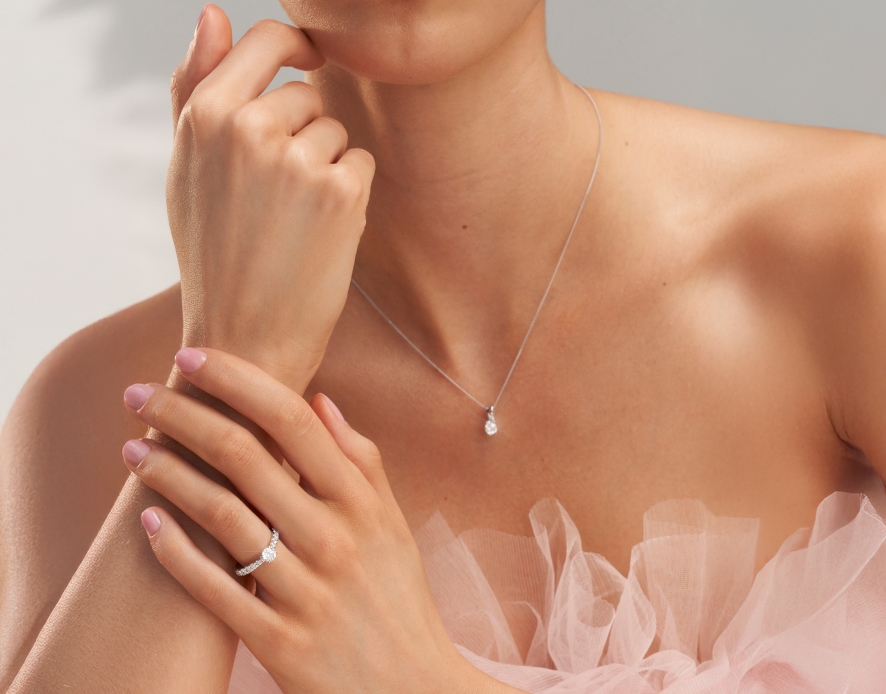
How are natural diamonds graded?
Natural diamonds are graded by independent gemmological laboratories such as the GIA (Gemological Institute of America). Each diamond’s inclusions, colour variations and unique formation conditions make it one-of-a-kind, contributing to its character and value.
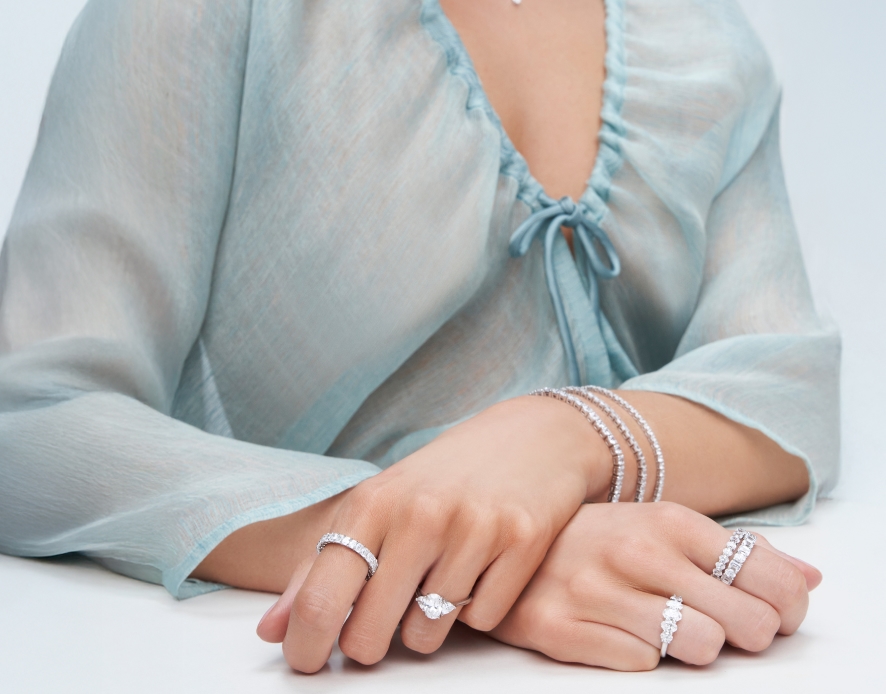
How are lab-grown diamonds graded?
Lab-grown diamonds are graded using the 4Cs at recognised labs. Because they are created under controlled conditions, they often have fewer inclusions and more consistent quality, but they are evaluated just like natural diamonds to give you the same level of transparency and confidence.
Appearance
Many wonder if you can visually distinguish between lab-grown and natural diamonds.
Can you tell the difference between lab-grown diamonds and natural diamonds?
To the naked eye, lab-grown and natural diamonds have the same sparkle and overall appearance as each other. Sparkle, fire and brilliance are determined by cut quality rather than origin. So, if you’re deciding between a natural diamond pendant and a similar style lab-grown necklace, it’s not easy to tell the difference.
Can a jeweller tell if a diamond is lab created?
The main difference between natural and lab-grown diamonds comes down to where it was formed, so jewellers would be unable to differentiate between the two without using specialist equipment.
How They’re Created
While natural and lab-grown are both considered diamonds, their formation is different. Natural diamonds are forged over billions of years under natural conditions deep in the Earth and then traditionally mined. Whereas lab-grown diamonds are cultivated in laboratories using controlled processes like High Pressure High Temperature (HPHT) or Chemical Vapour Deposition (CVD). Both processes produce diamonds with the same physical and chemical characteristics.
Comparing Lab Grown vs Natural Diamonds
Natural Diamonds |
Lab-Grown Diamonds |
|
|---|---|---|
Chemical Composition |
Carbon crystals, sometimes with impurities |
Carbon crystals, sometimes with impurities |
Appearance |
To the naked eye, will look the same as a lab-grown diamond when polished. |
To the naked eye, will look the same as a natural diamond when polished. |
Physical Structure |
Natural diamonds have complex, irregular structures shaped by the dynamic conditions of their geological formation. |
Growth patterns of lab-grown diamonds are typically uniform, reflecting the controlled laboratory environment in which they are created. |
Availability |
Rare and naturally limited in availability |
Improvements in technology have progressively increased their availability. |
Lab Grown vs Natural Diamonds – Which Should You Choose?
The decision comes down to what matters most to you. Lab-grown diamonds have the same optical, chemical and physical properties as natural diamonds. However, because lab-grown diamonds can be produced in abundance, they are less expensive and make owning a larger size stone more affordable. Their relative abundance may not ensure that the value will hold over time. .
Explore Ernest Jones’ full range of lab-grown and natural diamonds to find your perfect choice – from GIA-certified BLOOM lab-grown diamonds that are precisely crafted to traceable , responsibly sourced natural diamond collections like Origin by Ernest Jones, ARCTIC LIGHT and Leonardo Da Vinci Cut. Visit your nearest store or shop online to experience the brilliance of both lab-grown and natural diamonds for yourself.